I am now certified through the McMaster Medical Acupuncture program (2026). This training allows me to use acupuncture as part of my massage therapy treatments to further address sports injuries, TMJ dysfunction, headaches, back pain and more! Please note this can only be covered by health insurance plans as massage therapy and not under acupuncture. I am offering this 20 minute treatment as part of a massage or as an add on after the massage.
Category Archives: Uncategorized
We are moving!
Dear valued clients, our current building will be undergoing an extensive renovation and demolition, so for your comfort and safety, we are relocating as of October 15, 2025 to 282 Linwell Road, St. Catharines. All scheduled appointments will remain the same, and I will ensure all clients are aware of the new location before their appointment.

Link to Health History Form
New Patient Health History Form Link
Click HERE to access the health history form in order to fill out ahead of your initial appointment. This is also linked to the confirmation email you receive when booking appointments online, or sent to you directly prior to your appointment.

Update: Self Care and Ergonomics-Golfer’s edition
In my practice during the pandemic, I have observed that clients working from home have created a new set of challenges, and pain doesn’t go away just because you’re not at the office.
This is resulting in clients coming to me with more repetitive strain injuries than I have ever seen before at one time. They are experiencing new wrist, forearm, neck and low back pain which has developed or is aggravating previous conditions. As we head into golf and gardening season, this type of overuse becomes even more compacted.
I would like to address this in a way that helps us all get back on the prevention side of what we call ‘repetitive strain injury’ or ‘RSI’. Today’s post will be some simple forearm stretches that, if done daily, can make a world of difference for forearm and wrist health. The following is a forearm flexor stretch: As with any stretch if any pain occurs then discontinue, it is not a ‘no pain, no gain’ thing with stretching.
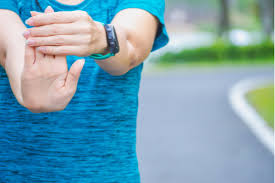
Now here is an example of how to stretch the opposite muscle group which are the forearm extensors. Make sure your elbow is straight for both stretches, and if comfortable, hold for 30 seconds and do both at least once daily especially if you are keyboarding all day.
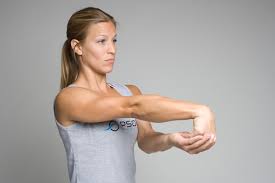
Forearm tension that has been going on for a few weeks or more can be more quickly resolved through massage therapy treatments, particularly with the aid of cupping therapy which I find to have the effect of ‘decompressing’ overused areas. Please see my page on cupping therapy to find out more about how it works.
For more acute pain, Julie offers ultrasound therapy- a non-invasive way to address inflammation. For example, your elbow pain, after a long week at the desk followed by a few rounds of golf- may be tender and sore to the point that even lighter massage techniques feel uncomfortable. The ultrasound unit, which employs sound waves that bounce off the tissues beneath the skin’s surface, can barely be detected as it glides over sensitive areas but can have effective, lasting results, preparing you to be at your best whether it’s at your job or your hobby!
Why You feel More Sore in the Morning
The circadian clock regulates inflammatory arthritis-FASEB journal
New research from the Federation of American Societies for Experimental Biology journal has described a gene protein that is created by our biological clock that represses inflammatory pathways within the limbs during the night.
The research focused on joint tissue cells which keep a 24 hour rhythm, called ‘fibroblast-like synoviocytes’, important cells in the pathology which underlies inflammatory arthritis. In the study, these cells were harvested from healthy joint tissue in mice and/or humans and when researchers ‘knocked out’ a gene that disrupted the 24 hour rhythm, there was an increased inflammatory response.
This suggests that gene product, called the CRYPTOCHROME (cry) protein, has significant anti-inflammatory effects during night time sleep, making inflammation symptoms, such as stiffness, seem worse when the affect wears off as you wake up.
For more information, sources please go to:http://dx.doi.org/10.1096/fj.201600353R